

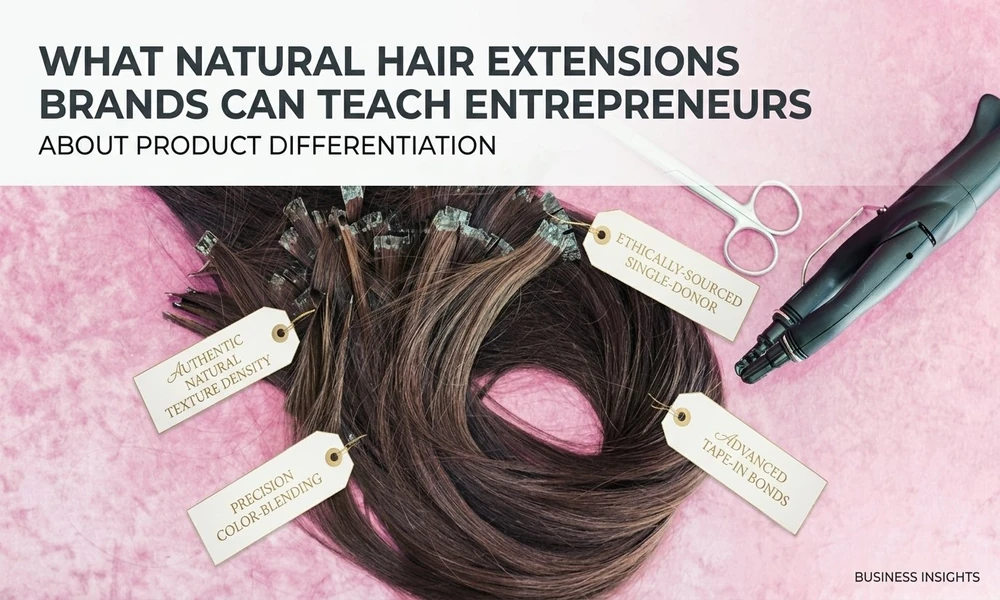
Standing out in a crowded market is one of the biggest challenges entrepreneurs face. When customers have dozens of similar products to choose from, competing on price alone rarely creates lasting success. Businesses need to offer something meaningful that customers cannot easily find elsewhere. The hair extension industry provides an excellent example of how specialization, customer understanding, and thoughtful product development can create competitive advantages. From offering realistic textures to developing convenient installation options, successful beauty companies demonstrate that differentiation goes beyond attractive packaging or clever advertising. Their strategies offer valuable lessons for entrepreneurs across industries, particularly those looking to build recognizable brands, increase customer loyalty, and grow without constantly lowering their prices.
1. Product Differentiation Begins With Understanding Customer Needs
Textured and natural hair comes in many curl patterns, densities, and styling preferences, making it difficult for a single product to satisfy every customer. This is whereNatural Hair Extensions Brands demonstrate the value of specialization. Companies such as ONYC® Hair offer products designed around specific textures, styling goals, and installation preferences rather than relying entirely on generic extension options.
This approach illustrates an important business principle: product differentiation means creating meaningful distinctions that make an offering more relevant to a particular audience. Those differences might involve product features, quality, convenience, customer experience, or specialized functionality.
For entrepreneurs, the opportunity often lies in identifying needs that larger competitors overlook. A smaller company does not necessarily need a bigger catalog or lower prices to succeed. It needs a compelling reason for customers to choose its products.
Before developing a new offering, business owners should consider several questions:
- What problems do customers repeatedly encounter?
- Which preferences are underserved by existing competitors?
- What product improvements would make customers’ lives easier?
- Why would someone choose this solution over familiar alternatives?
Answering these questions helps founders invest in features that customers genuinely value rather than innovations that simply look impressive.
2. Product Innovation Should Make Everyday Experiences Easier
Innovation does not always require inventing an entirely new product category. Sometimes, the most valuable improvement involves making an existing solution more accessible, flexible, or convenient. In competitive industries, practical improvements can influence purchasing decisions just as strongly as technological breakthroughs.
Consider customers with textured or natural hair who want additional volume without committing to a traditional sew-in installation. Someone searching for theBest Clip In Hair Extensions may prioritize a realistic texture match, comfortable application, and the freedom to change hairstyles without a lengthy salon appointment.
For beauty businesses, offering removable extensions alongside traditional bundles creates opportunities to serve customers with different routines and styling expectations. One shopper might prefer a long-lasting installation, while another values the convenience of switching between professional, casual, and special-occasion looks.
The broader lesson is that convenience can become a powerful differentiator. Entrepreneurs should look beyond what their products do and examine how easily customers can incorporate those products into everyday life.
Practical innovation may involve simplifying setup instructions, introducing flexible purchasing options, improving product accessibility, or creating variations for customers with distinct needs. Small improvements that eliminate common frustrations can strengthen a company’s competitive position.
3. Customer Research and Feedback Create Better Products
Successful product development begins with listening. In the beauty industry, customer concerns about texture matching, maintenance, shedding, installation, and longevity can reveal opportunities that may not be obvious during initial product planning.
Entrepreneurs can collect useful insights through customer reviews, support conversations, surveys, social media discussions, and purchasing patterns. Rather than treating complaints as isolated problems, businesses should look for recurring themes that indicate unmet expectations.
For example, repeated requests for easier installation could justify developing beginner-friendly alternatives. Questions about product durability might indicate a need for clearer care instructions, stronger quality controls, or improvements in material selection.
However, collecting feedback is only the beginning. Companies must organize what they learn, prioritize meaningful improvements, and measure customer responses after implementing changes.
A useful process involves identifying a recurring problem, testing a potential solution with a small customer group, gathering feedback, and refining the offering before expanding production. This reduces unnecessary development costs while keeping innovation connected to actual demand.
4. Brand Identity and Quality Build Long-Term Competitive Advantages
Differentiation becomes more effective when customers understand what a company stands for. In the hair extension market, a brand focused on realistic textures and specialized styling solutions communicates a clearer promise than one attempting to appeal to every possible customer.
This principle applies across industries. A recognizable brand identity helps businesses establish expectations, develop consistent messaging, and connect with people whose priorities align with their offerings. Specialized positioning can also improve marketing efficiency because businesses can create content addressing specific purchasing concerns.
Still, positioning alone cannot sustain customer trust. Product quality must support the brand’s promises. Hair companies, for instance, need consistent texture representation, dependable construction, accurate descriptions, and practical maintenance guidance to help customers make informed decisions.
Quality assurance should therefore be treated as a continuous business responsibility rather than a final inspection. Entrepreneurs can strengthen consistency through supplier evaluations, documented product standards, sample testing, and systematic analysis of returns or complaints.
When a business combines clear positioning with reliable performance, customers have stronger reasons to return, recommend its offerings, and perceive value beyond price.
Practical Lessons for Founders
The hair extension industry demonstrates that sustainable differentiation comes from solving specific customer problems exceptionally well. Entrepreneurs can apply the same thinking whether they sell physical products, digital services, or specialized professional solutions.
Instead of attempting to outperform every competitor on every feature, focus on understanding a defined audience, delivering dependable quality, and improving the details that matter most to customers. Meaningful innovation does not have to be dramatic; it simply needs to make the customer experience noticeably better.
Ultimately, a strong business is not necessarily the one offering the most products. It is the one customers recognize for providing the right solutions, consistently and with a clear sense of purpose.
